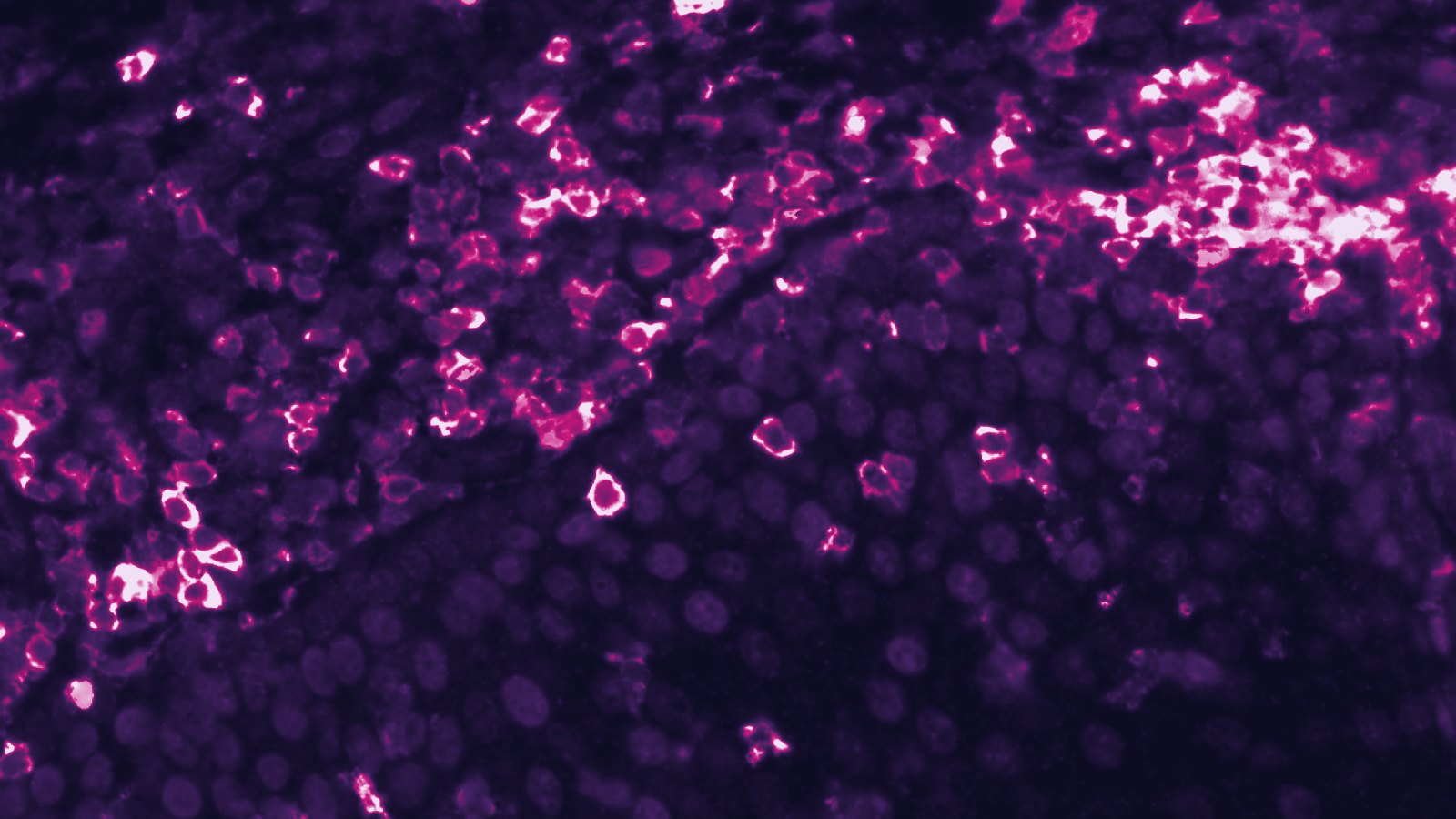
Michel Sadelain's group reports in Science Immunology that tumor necrosis factor made by the infused CAR T cells sits upstream of the host macrophage response behind severe cytokine release syndrome. Selectively disrupting TNF signaling in a mouse model reduced the accumulation of pro-inflammatory monocyte-derived macrophages at the tumor site and cut host production of IL-6 and IL-1 beta. In humanized xenochimeras, TNF governed the overall course of the syndrome, lethality included.
- Paper: Science Immunology, volume 11, issue 122, article eaea6276, published Aug. 21, 2026.
- Lead authors: first author P.L. Lindenbergh, listed at both the Columbia Institute for Cell Engineering and Therapy and the hematology department of Amsterdam UMC; senior author Michel Sadelain at Columbia's Vagelos College of Physicians and Surgeons.
- Collaborators: OverT Bio in New York, Universite Paris Est Creteil and INSERM U955, University Hospital Regensburg, Sunnybrook Research Institute in Toronto.
- Systems used: a mouse CRS model with TNF signaling selectively disrupted, plus humanized xenochimeras.
- Access: no PubMed Central deposit; science.org returned 403 to every request, so what follows rests on the published abstract and on the group's earlier work.
An upstream signal the 2018 model had ruled out
In June 2018 the same laboratory published a murine CRS model in Nature Medicine that developed within two to three days of CAR T infusion, proved lethal at high tumor burden, and responded to IL-6 receptor blockade. Its conclusion was that severity was "mediated not by CAR T cell-derived cytokines, but by IL-6, IL-1 and nitric oxide (NO) produced by recipient macrophages." Giavridis led that work from Sadelain's laboratory at the Sloan Kettering Institute. The 2026 paper reverses that order: a cytokine made by the engineered cells sits above the macrophage compartment that produces the effectors, which makes the infused product itself a point of intervention rather than only a trigger.
Antitumor activity goes unmentioned in the abstract
The abstract describes TNF as acting before the host cytokines that clinicians measure, promoting macrophage accumulation at the tumor site and inducing IL-6 and IL-1 beta downstream. That places the decisive event inside the first days, at a tissue site rather than in the circulation. Two things the abstract does not report matter for anyone weighing the finding: whether disrupting TNF preserved the antitumor activity of the CAR T cells, and whether any patient samples were examined alongside the mouse work. Neither appears in the summary, and the subscription wall at AAAS blocked the methods and figures.
TNF blockade is absent from the CADTH options
A Canadian rapid review published in May 2024 as CADTH report RC1534 set out the options in use. Tocilizumab, an anti-IL-6 receptor antagonist, carries FDA and Health Canada approval for severe or life-threatening CRS. Corticosteroids play an important role in CRS management and are the mainstay for immune effector cell-associated neurotoxicity syndrome. The anticytokine drugs the review examined were tocilizumab, anakinra and siltuximab. TNF blockade was not among them.
Why This Matters to the APO|APE Reader
Giavridis now lists OverT Bio in New York on the byline, which puts one author of both the 2018 and 2026 papers inside a company whose business is engineered T cells. An upstream cytokine made by the infused product can be blocked with a second antibody at the bedside, or removed from the cell during manufacture, and those two routes answer to different regulators, different release specifications and different reimbursement. A blocking antibody can be withheld from a patient whose disease is responding. A cell engineered to make less TNF cannot be un-engineered after infusion.
Sources
- Lindenbergh PL, Giavridis T, Vivier O, Lopez MA, Dobrin A, Mack M, Cohen JL, Themeli M, Sadelain M. CAR T cell-derived TNF is an early determinant of cytokine release syndrome severity. Science Immunology, volume 11, issue 122, eaea6276, August 21, 2026. doi:10.1126/sciimmunol.aea6276
- Giavridis T, van der Stegen SJC, Eyquem J, Hamieh M, Piersigilli A, Sadelain M. CAR T cell-induced cytokine release syndrome is mediated by macrophages and abated by IL-1 blockade. Nature Medicine, volume 24, issue 6, pages 731-738, June 2018
- Anticytokine Therapy and Corticosteroids for Cytokine Release Syndrome and for Neurotoxicity Following T-Cell Engager or CAR T-Cell Therapy. CADTH Health Technology Review, Report RC1534, Canadian Agency for Drugs and Technologies in Health, May 2024