Serum epidermal growth factor measured before treatment separated melanoma patients who achieved disease control from those who did not, at a threshold of 229.2 pg/mL and an area under the curve of 0.721 across 58 patients pooled from three TILT-123 trials. The analysis comes from TUNINTIL, a 17-patient phase I in which checkpoint-refractory patients received tumor-infiltrating lymphocytes with neither lymphodepleting chemotherapy nor interleukin-2 support.
- Publication: Journal for ImmunoTherapy of Cancer, August 20, 2026, 14(8):e016003, open access under CC BY-NC.
- Trial: TUNINTIL, NCT04217473, first-in-human open-label dose escalation across multiple centers and countries; 17 patients with checkpoint-inhibitor-resistant metastatic melanoma received up to six intratumoral TILT-123 injections before TIL infusion.
- Follow-up: clinical data cut-off September 15, 2025, survival updated to March 2026; overall survival ran from 75 days to more than 1,570 days, with 5 of 17 patients alive at cut-off.
- Signature: at day 36, before the cells went in, patients without disease control had higher IL-6, HGF, VEGF-A, IL-8, CCL17 and CCL14.
- Platform: Olink Target 96 Immuno-Oncology panel from Thermo Fisher, reported as NPX values and as absolute pg/mL for baseline samples.
- Sponsor ties: seven of the 28 authors, including senior author Akseli Hemminki, list TILT Biotherapeutics Oy of Helsinki as an affiliation.
Seventeen patients, no conditioning regimen
TILT-123, generic name igrelimogene litadenorepvec, is an adenovirus armed with tumor necrosis factor and interleukin-2. The design used it in place of the lymphodepleting chemotherapy and high-dose interleukin-2 that adoptive TIL therapy conventionally requires, on the reasoning that conditioning toxicity limits who can be treated at all. Median age was 67, range 25 to 75, with nine women and eight men across cutaneous, mucosal and uveal subtypes. By RECIST 1.1 the disease control rate among evaluable patients was 35.3% at day 36 and 37.5% at day 78, with objective responses in 2 of 16 at day 78. PET-based disease control ran higher, 62.5% at day 36 and 46.6% at day 78. Median overall survival was 360 days in patients who never achieved disease control and was not reached in those who did, a separation the authors report at p=0.0154.
Progressors already differed in serum on the day of infusion
The day 36 serum draw was taken immediately before TIL infusion. Patients who went on to progress already had significantly higher IL-6, hepatocyte growth factor, VEGF-A, IL-8, CCL17 and CCL14. Two of those, CCL17 and HGF, were elevated at baseline before any treatment. Circulating monocytic myeloid-derived suppressor cells followed the same pattern at day 36 (p=0.0168), and the six-protein panel stayed elevated through days 50 and 64. Baseline HGF above the cohort median predicted shorter overall survival within TUNINTIL alone (p=0.0322), while EGF, IL-8, VEGF-A, CCL3 and CCL4 did not reach significance in a cohort of 17.
Pooling three trials put the cut-off at 229.2 pg/mL
To get past that sample size the authors pooled baseline serum data from TUNIMO, TUNINTIL and PROTA, reaching 58 patients. Receiver operating characteristic analysis put baseline EGF at an area under the curve of 0.721 with an optimal cut-off of 229.2 pg/mL, against 0.553 for HGF. Combining the two added essentially nothing, at 0.722. The EGF threshold classified 44 of 58 patients correctly, 19 of 23 with disease control and 25 of 35 without, for 75.9% accuracy, 82.6% sensitivity and 71.4% specificity. Applied across trials, elevated baseline HGF and EGF both predicted shorter overall survival (p=0.0028 and p=0.0288). Restricting TUNINTIL to the nine patients below the EGF cut-off shifted the objective response rate from 11.7% to 22.2% and the disease control rate from 35.2% to 77.8%.
CD8 and CD4 rose in uninjected metastases too
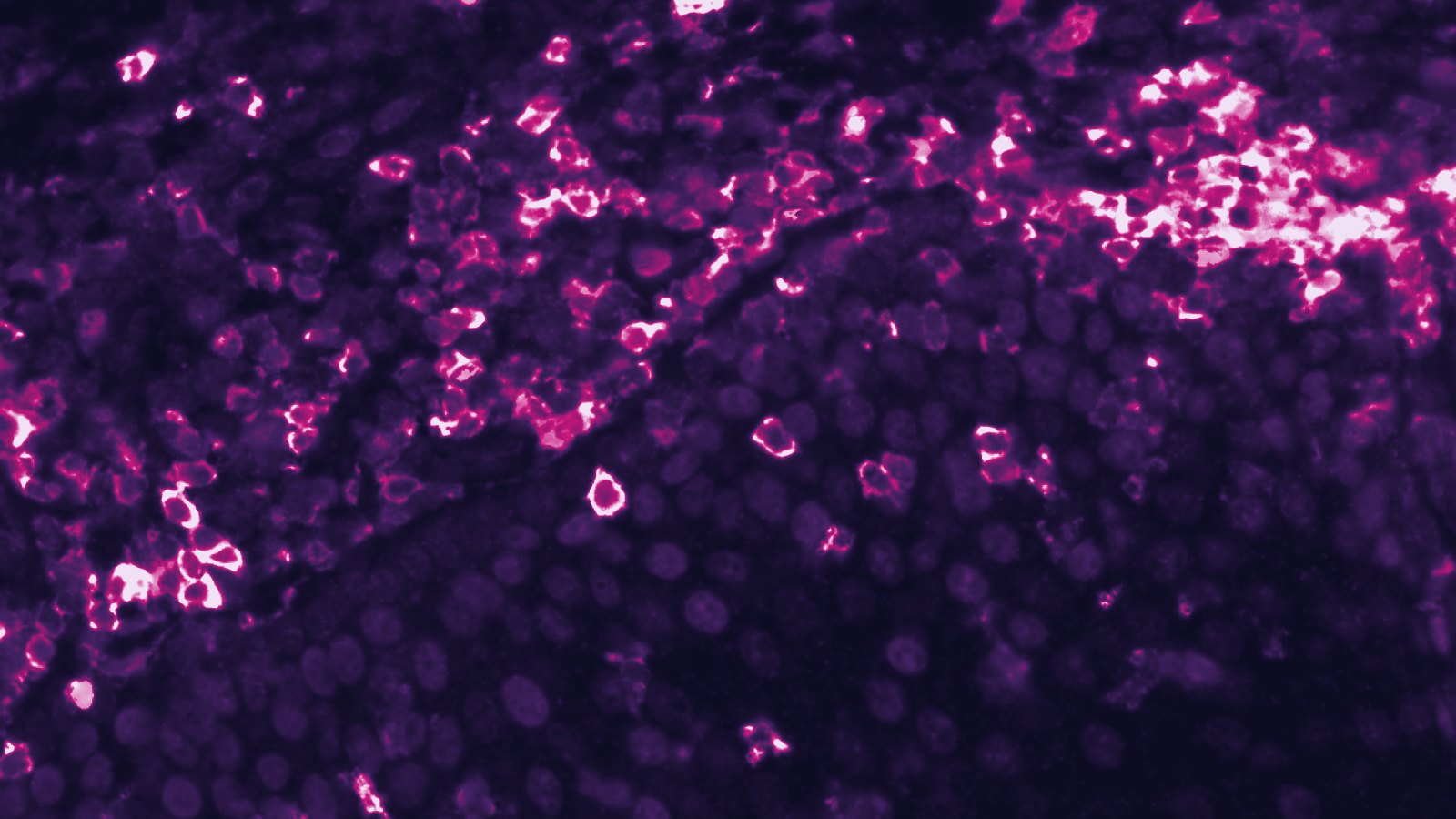
Serial tumor sampling was read by multiplex immunofluorescence quantified in Indica Labs HALO software through Oracle Bio, alongside hematoxylin and eosin and adenovirus E1A immunohistochemistry. By day 64, intratumoral CD8 and CD4 T cell proportions were significantly raised over baseline in both injected and non-injected metastases (p=0.0342 and p=0.0343). FoxP3-positive regulatory T cells stayed constrained in injected lesions and PD-L1 expression in tumor was stable across both sites. Patient 10,107, a complete responder, supplied the illustrative series. Viral DNA, quantified by PCR against the IRES-IL2 region, was detectable in tumor in only a subset of patients.
Limits the authors put on their own numbers
Their stated constraints are the small cohort, a mixed population spanning three melanoma subtypes with varying prior treatment, reliance on blood sampling that cannot capture spatial structure in the tumor, and no correction for multiple testing across exploratory endpoints. Two observations carry the authors' own speculative label: a complete response in a patient with von Willebrand disease, and better survival in patients whose baseline activated partial thromboplastin time sat at or above the median, which they read as a possible low-platelet-activation phenotype. Heavily pretreated patients carried more terminally differentiated CD8 T cells at baseline and lived less long (p=0.0344).
Why This Matters to the APO|APE Reader
The 229.2 pg/mL threshold was derived and evaluated on the same 58 patients with no held-out cohort, so 75.9% accuracy is an in-sample figure that will move on an independent cohort. The authors also note that serum EGF is largely platelet-derived during activation and clotting, which turns tube type, clotting interval and centrifugation into part of the measurement rather than background handling detail. Reproducing this cut-off means pinning down those preanalytics and porting the readout from a research NPX panel to a validated immunoassay before a single number in pg/mL can gate who starts an intratumoral dosing course.
Sources
- Haybout L, Kudling TV, Clubb JH, et al. Immune-cytokine signature predicts survival in patients with advanced melanoma treated with oncolytic adenovirus TILT-123 and chemotherapy- and IL-2-free adoptive TIL therapy. J Immunother Cancer. 2026;14(8):e016003. PMID 42624531
- TNFalpha and Interleukin 2 Coding Oncolytic Adenovirus TILT-123 During TIL Treatment of Advanced Melanoma (TUNINTIL), NCT04217473. ClinicalTrials.gov